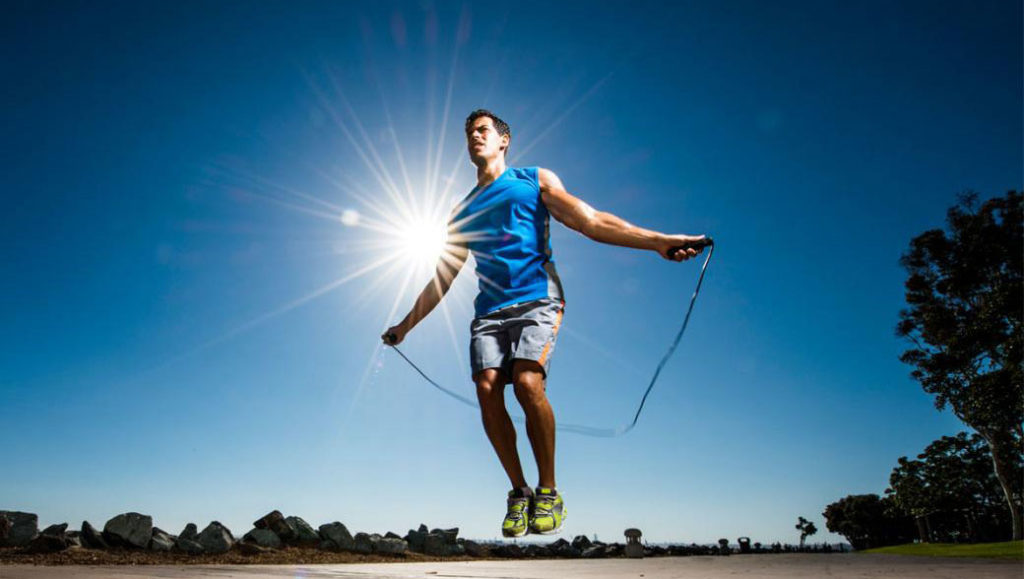
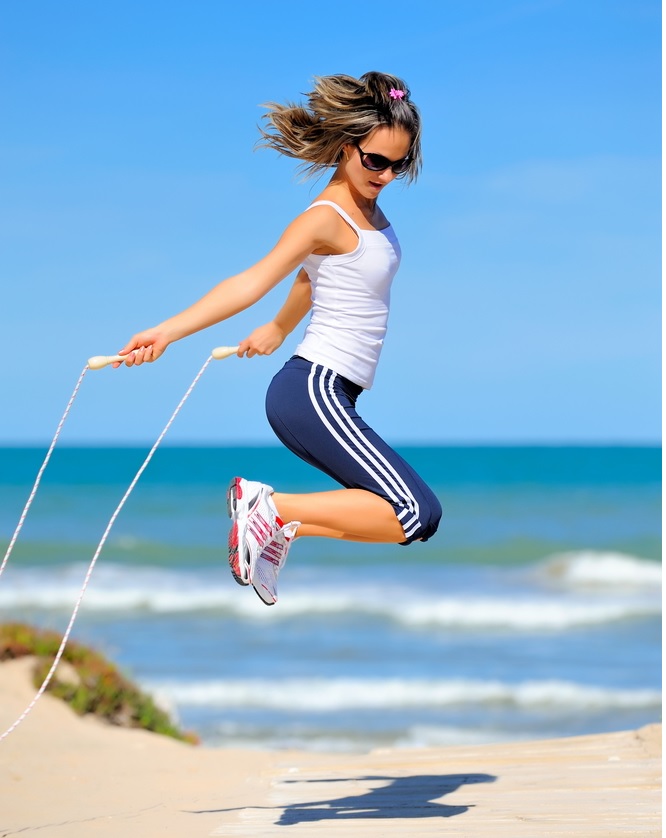
Jumping rope? Isn’t that for boxers — and, um…little girls? Well, believe it or not the simple act of jumping rope can do more for you overall than the same time spent jogging. Jumping rope is also easy to do anywhere. A jump rope slipped in your backpack or bag can be brought along on a trip, to work, school or done in the living room while you’re watching your kids — or watching TV.
To start jumping rope, head to your nearest sporting goods store and get a rope. While you probably don’t want to get a lightweight rope from the toy department for a workout, if that’s all you’ve got, it will work. Plastic ropes are usually used in gyms and they are a little easier to use for speedwork. Once you have your rope, make sure it fits you comfortably. Most ropes range from 8 to 10 feet long. You can cut it to adjust it – but once you cut it you can’t make it longer. Stand on the middle of the rope and hold the handles comfortably at waist height. Adjust accordingly.
Pick a nice, flat surface to jump on like a gym mat or concrete floor. Something that gives a bit will be more comfortable but if you choose a grassy or dirt surface — as I have to do out here in the middle of nowhere — make sure there is nothing in the way like rocks, sticks, grass that’s very long, that kind of thing.
The benefits of jumping rope are many. Here are a few you might not have known about:
1. Improves Coordination
Jumping rope actually improves your coordination by making you focus on your feet. Whether or not you’re paying attention to them, your brain is aware of what your feet are doing. This practice, over and over again, makes you “lighter” on your feet. Training for one of those warrior-style obstacle course races? Jumping rope can help. According to expertboxing.com‘s Boxing Training Guide, “the more tricks you do with the jump rope, the more conscious and coordinated you have to be.”
2. Decreases Foot and Ankle Injuries
Jumping rope is beneficial for those active in other sports. Many athletes in basketball, tennis, football and other sports often suffer foot and ankle injuries from running and then stopping quick and turning. This is very common in both tennis and basketball. Jumping rope not only improves your foot coordination but also increases your strength in the muscles surrounding your ankle joint and in your foot, decrease the chance of injury to those areas. According to the Jump Rope Institute, “jumping rope teaches players to stay on the balls of their feet, as opposed to being flat footed or on their heels. And since you are on your toes the entire time you jump rope, you will find that staying quiet on your toes when playing tennis will become easier and second nature.”
3. Burns Major Calories
Compared to jogging for 30 minutes, jumping rope actually burns more calories. According to Science Daily, “This aerobic exercise can achieve a “burn rate” of up to 1300 calories per hour of vigorous activity, with about 0.1 calories consumed per jump.Tenminutes of jumping rope can roughly be considered the equivalent of running an eight-minute mile.”
4. Completely Portable and Fun
A jump rope can go anywhere with you. Take it to work, take it to school. Warm up before your basketball game or cool down after a bike ride. Learn to do tricks and double dutch with your kids or have competitions between you and your family — how long, how low you can jump, how high, spinning — all kinds of tricks can be done with a jump rope.
5. Improves Bone Density
Dr. Daniel W. Barry, an assistant professor of medicine at the University of Colorado, at Denver, and a researcher who has studied the bones of the elderly and of athletes, says that the best exercise to improve bone density is simply jumping up and down. “Jumping is great, if your bones are strong enough to begin with,” Dr. Barry says. “You probably don’t need to do a lot either.” (If you have any history of fractures or a family history of osteoporosis, check with a physician before jumping.)
According to The New York Times, “in studies in Japan, having mice jump up and land 40 times during a week increased their bone density significantly after 24 weeks, a gain they maintained by hopping up and down only about 20 or 30 times each week after that.”
6. Improves Cardiovascular Health
According to the American College of Sports Medicine, skipping rope is highly recommended for aerobic conditioning. In order to increase your heart and lung health you must do it three to five times per week for 12 to 20 minutes at a time.
7. Improved Breathing Efficiency
In addition to improved heart health and stamina, jumping rope also improves how efficiently you breathe. This becomes very beneficial when doing other activities because you won’t be as out of breath after running down the court or swimming laps in the pool.
8. Makes You Smarter
Believe it or not, jumping rope can make you smarter. According the Jump Rope Institute, jumping aids in the development of the left and right hemispheres of your brain, which further enhances spacial awareness, improves reading skills, increases memory and makes you more mentally alert. Jumping on the balls of your feet requires your body and mind to make neural muscular adjustments to imbalances created from continuous jumping. As a result jumping improves dynamic balance and coordination, reflexes, bone density and muscular endurance.
9. Improves Your Ability to Stay Calm
Because you are actually working your brain and your body at the same time, boxers in the ring who jump rope actually are more calm overall than those who don’t. The Jump Rope Institute attributes this to the biomechanical perspective. “As one dissects this exercise further and views it from a biomechanical perspective, it represents a composite movement combining a circular motion with an angular momentum. The body resembles a projectile subject to all the laws that govern projectile motion while the rope becomes a dynamic flywheel subject to all the laws that govern rotary motion. It is in the synchronous and harmonious coordination of these movements where the secrets and benefits are received.”
Your improved ability to jump rope and be synchronous with your body, mind and the rope, can actually help you be more calm in other situations.
Grab a jump rope, get hopping and be amazed by the different ways your body and mind will benefit.
The effect of exercise on health is profound. It can protect you from a range of conditions, including heart disease, type 2 diabetes and some cancers. But the type and amount of exercise you should do changes as you age. To ensure that you are doing the right type of exercise for your age, follow this simple guide. Childhood and adolescence In childhood, exercise helps control body weight, builds healthy bones and promotes self-confidence and healthy sleep patterns. The government recommends that children should get at least one hour of exercise a day. As a tip:
Children should try a variety of sports and develop skills, such as swimming and the ability to hit and kick a ball.
Lots of non–scheduled physical activity is great, too, such as playing in playgrounds.
Exercise habits tend to steadily decline during teen years, particularly in girls. Getting enough exercise promotes a healthy body image and helps manage stress and anxiety. You can also:
Encourage teenagers to keep one team sport, if possible.
For teenagers who are not into team sports, swimming or athletics can be a good way to keep fitness levels up.
In your 20s You are at your absolute physical peak in your mid-20s, with the fastest reaction times and highest VO2 max – the maximum rate at which the body can pump oxygen to muscles. After this peak, your VO2 max decreases by up to 1% each year and your reaction time slows each year. The good news is that regular physical activity can slow this decline. Building lean muscle mass and bone density at this age helps you retain them in later years.
Vary your training and keep it fun. Try tag rugby, rowing or boot camp.
If you are a regular exerciser, get advice from an exercise professional to build “periodisation” into your training regime. This involves dividing your training regime into progressive cycles that manipulate different aspects of training – such as intensity, volume and type of exercise – to optimise your performance and ensure you peak for a planned exercise event, such as a triathlon.
In your 30s As careers and family life for many intensify in their 30s, it is important that you maintain cardiovascular fitness and strength to slow normal physical decline. If you have a sedentary job, make sure you maintain good posture and break up long periods of sitting by forcing activity into your day, such as routing your printer to another room, climbing a flight of stairs to use the bathroom on another floor, or standing when taking a phone call so you are moving every half an hour where possible.
Work smart. Try high-intensity interval training. This is where bursts of high-intensity activity, up to 80% of your maximum heart rate, such as sprinting and cycling, are broken up with periods of lower-intensity exercise. This kind of workout is good for the time poor as it can be done in 20 minutes.
For all women, and especially after childbirth, do pelvic floor exercises, sometimes known as Kegel exercises daily to help prevent incontinence.
Diversify your exercise programme to keep it interesting. Try boot camp, spin class or yoga.
In your 40s Most people start to put on weight in their 40s. Resistance exercise is the best way to optimise calorie burning to counteract fat accumulation and reverse the loss of three to eight percent of muscle mass per decade. Ten weeks of resistance training could increase lean weight by 1.4kg, increase resting metabolic rate by 7% and decrease fat weight by 1.8kg.
Try kettlebells or start a weight-training programme in your gym.
Take up running, if you don’t run already, and don’t be afraid to start a more intensive exercise programme. You get more bang for your buck with running versus walking.
Pilates can be useful to build core strength to protect against back pain, which often starts in this decade.
In your 50s In this decade, aches and pains may crop up and chronic conditions, such as type 2 diabetes and cardiovascular disease, can manifest. As oestrogen declines in postmenopausal women, the risk of heart disease increases.
Do strength training twice a week to maintain your muscle mass.
Weight-bearing exercises, such as walking, is recommended. Walk fast enough so that your breathing rate increases and you break a sweat.
Try something different. Tai chi can be excellent for balance and relaxation.
In your 60s Typically, people accumulate more chronic conditions as they get older, and ageing is a major risk factor for cancer. Maintaining a high level of physical activity can help prevent cancers, such as post-menopausal breast cancer, colon cancer and cancer of the womb, and it reduces the risk of developing chronic conditions, such as heart disease and type 2 diabetes.
Physical activity tends to decline with age, so keep active and try to buck this trend.
Try ballroom dancing or other forms of dancing; it’s a fun and sociable way to exercise.
Incorporate strength and flexibility exercises twice a week. Aqua-aerobics can be a great way to develop strength using water as resistance.
Maintain cardiovascular exercise, such as brisk walking.
70s and beyond Exercise in your 70s and beyond helps prevent frailty and falls, and it’s important for your cognitive function. If you have a period of ill health, try to keep mobile, if possible. Strength and fitness can decline rapidly if you are bed bound or very inactive, which can make it hard to get back to previous levels.
Walk and talk. Instead of inactive visits from family and friends, go for a walk together. It will keep you motivated and boost your health more than solitary exercise.
Incorporate some strength, balance and cardiovascular exercise in your regime. But get advice from a physiotherapist or other exercise professional, especially if you have several chronic conditions.
The main message is to keep moving throughout your life. Sustained exercise is what benefits health most.
Julie Broderick, Assistant Professor, Physiotherapy, Trinity College Dublin
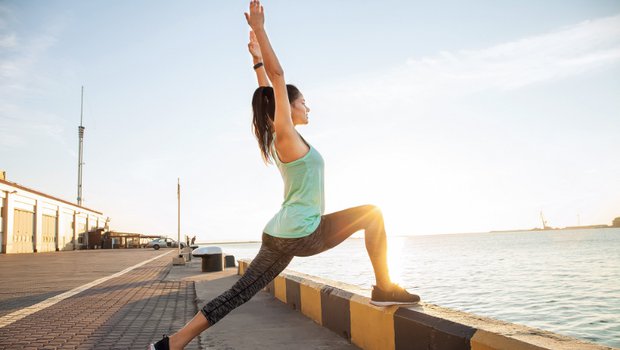
A person with good health and fitness becomes able to live their life to its fullest extent. It is very important for a person in life to be physically and mentally fit to live a healthy and happy life. Healthy and fit people become less prone to medical conditions. Fitness does not mean to be only physically fit, it also means to have a healthy mental state mind. The simple way to remain healthy and fit is by having a stress free mind, this can be done by regular exercise and balanced diet. People who maintain their ideal weight become less prone to cardiac and other health problems. People who are physically active can easily maintain a relaxed state of mind.










 Good health and fitness